
We all have heard the saying "do not put all eggs in one basket”. This is a piece of advice which means that one should not concentrate all efforts and resources in one area as one could lose everything. In investment terms this refers to Asset Allocation where your money is the egg and asset is the basket. As per Wikipedia, Asset allocation is the implementation of an investment strategy that attempts to balance risk versus reward by adjusting the percentage of each asset in an investment portfolio according to the investor’s risk tolerance, goals, age and investment time frame.
A Rule of thumb for allocation based on investor’s age is the simplest way to decide on the asset allocation. 100 minus one’s age can give you the equity allocation. Simply said, the more old you grow, the more the allocation increases to fixed income instruments. But this is not always true and depends on the investor’s risk taking capability.
The importance of asset allocation is understood by experts and advisors but somehow the retail investor gets generally lost. Nifty moved from 12,000 levels in February to a low of 7511 in March and back to 12,000 in a matter of eight months. This was the time to correct the allocation by hiking their SIPs in equity funds or through lumpsum investments but many investors actually stopped SIPs. Some even withdrew their investments. This turned their notional losses into permanent ones. Now that markets have recovered, investors who panicked and withdrew have missed all the upside.
The investors need to be prudent to do profit booking when a certain asset class becomes overheated. In case of a portfolio the allocations need to be rebalanced. All asset classes don’t move at the same pace or in the same direction. Rebalancing realigns the portfolio so that exposure to underweight assets is increased and overweight assets are dumped. So despite the changes in the market, the portfolio will always have the same risk-reward expectations.
But does it always work that way? I am afraid, the answer to this is — mostly no . Investors tinker with allocation imposing their own perspectives on their well-made asset allocation models. Greediness takes over logical thinking when the going is good. Exposures are not reduced but in-fact increased when a certain asset is peaking thus increasing risk in the portfolio.
Unfortunately the opposite also holds true. Many investors lose their nerve when markets go into a tailspin. Investments are taken out at a loss even though it’s the time to increase weightage to keep the asset allocation aligned.
Investors who want to gain from asset allocation must first need to unlearn. Many asset allocation models have been made by financial advisors to help the investors. These models take into account their risk taking capabilities The investor’s expectations once aligned to risk, both on the upside and downside form basis of good asset allocation.
Below are the returns from the various asset classes over the years. Clearly shows that not every basket will give you the returns. The three main asset classes — equities, fixed-income, and cash and equivalents — have different levels of risk and return, so each will behave differently over time.
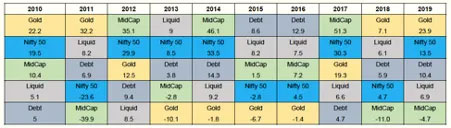
As per the book " Determinants of Portfolio Performance” by Gary Brinson, 93.6% of portfolio performance over time can be attributed to asset allocation. Each asset goes through its own cycle and the smart investor stays diversified to unlock the power of asset allocation.
Once a model is chosen, let it work. The baskets (assets) are meant to protect your eggs (portfolio) in tough market conditions !
